SELLING OFFER
Seek co-innovation with global enterprises and governmental institutions
Port Guardian AI (Patent-Based AI Carbon Measurement Platform)
11 2026. 1. 12.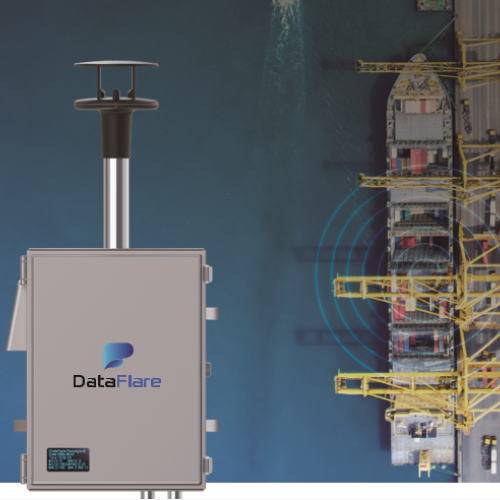
Summary
Ports worldwide face increasing pressure to demonstrate transparent, verifiable compliance with international carbon and air pollution regulations. Existing emission management approaches largely rely on estimated data derived from fuel consumption models, which lack accuracy, traceability, and regulatory credibility. However, PORT GUARDIAN AI addresses these limitations by providing a land-based, AI-powered platform that directly measures vessel emissions in real time and attributes them to individual ships.
Advantages and Innovations
The technology consists of an integrated hardware, software system designed for continuous, non-intrusive monitoring of vessel emissions from land-based installations. Core components include multi-gas emission sensors, an AIS receiver, wind direction and speed sensors, and an edge communication module with LTE connectivity.
These elements operate together to collect synchronized environmental and vessel movement data. A patented wind backtracking algorithm analyzes atmospheric dispersion patterns to trace detected pollutants back to their emission sources, enabling vessel-level attribution without onboard installation. The system supports measurement of particulate matter (PM2.5) and gaseous pollutants such as CO₂, SO₂, NO₂, and CO, with high temporal resolution and industrial-grade accuracy.
Data is transmitted to a cloud-based AI analytics platform that visualizes emission paths, identifies high-emission vessels, and generates verified reports aligned with international regulatory frameworks. The architecture is modular and scalable, allowing integration with drones, satellites, smart ship systems, and digital twin platforms.
Optional AI-based video analytics can further enhance source identification by distinguishing vessel emissions from other port-related pollution sources. Through one year of testing with Ulsan Port Authority, and the execution of MOUs with Singapore and Denmark, the company is achieving performance-driven carbon reduction and ESG compliance.
Key values are the following:
• Direct Measurement, Not Estimation: Replaces fuel-based emission estimates with real-world, sensor-based data
• Vessel-Level Accountability: Attributes emissions to individual ships using patented wind backtracking technology
• Land-Based Installation: No onboard retrofitting required, minimizing operational disruption
• Regulatory-Grade Data: Generates verified datasets suitable for IMO and EU carbon reporting
• Three-Phase Monitoring: Captures emissions during entry, berthing, and departure for higher analytical accuracy
• Scalable Architecture: Compatible with smart port, digital twin, and ESG data ecosystems
• Risk Management Tool: Enables ports and operators to proactively manage environmental, regulatory, and reputational risk.
Stage of Development
Description
The system supports high-precision measurement of particulate matter (PM2.5) and key gaseous pollutants including CO₂, SO₂, NO₂, and CO, delivering high temporal resolution and industrial-grade accuracy suitable for regulatory and operational use. All collected data is transmitted in real time to a cloud-based AI analytics platform, where it is processed, visualized, and analyzed to map emission dispersion paths, identify high-emission vessels, and generate verified reports aligned with international regulatory frameworks such as IMO and EU MRV.
The system architecture is modular and highly scalable, enabling seamless integration with drones, satellite data sources, smart ship systems, port infrastructure, and digital twin platforms. This ensures long-term adaptability as port digitalization and environmental monitoring requirements evolve. In addition, optional AI-based video analytics further enhances source attribution by distinguishing vessel emissions from other port-related pollution sources such as cargo handling equipment and nearby industrial facilities.
Through over one year of operational testing in collaboration with the Ulsan Port Authority, and the execution of strategic MOUs with partners in Singapore and Denmark, the company is demonstrating measurable, performance-driven carbon reduction outcomes while supporting ESG compliance and data-driven environmental governance.
Technology Keywords
Market Application Keywords
Sector Group
Type and Size of Client
Type and Role of Partner Sought
Port Authorities & Terminal Operators: Deployment for regulatory compliance and environmental risk management
Smart Port & SI Companies: System integration within digital port platforms and smart infrastructure projects
Government & Regulatory Agencies: Pilot programs, policy validation, and environmental monitoring initiatives
ESG & Carbon Management Firms: Data partnerships for verified reporting, auditing, and advanced analytics services
Type of Partnership Considered
Company
Internal Reference
Category
Express your interest in this opportunity.